Crowns, Bridges & Fillings in Esquimalt, BC
What Our Patients Say
Save Your Natural Teeth, Save Your Natural Smile
Fit, Function, and a Natural Appearance
Restorative work is as much about fit and feel as it is about appearance. We use digital scanning and carefully selected materials to ensure every restoration sits comfortably in your mouth, functions correctly with your bite, and looks natural alongside your surrounding teeth.
Most Cases, Handled Here
From a simple filling to a more involved crown or custom inlay, most restorative treatment at Highrock Dental is handled in-house from start to finish. You see the same dentist at every stage, which means your care stays consistent and nothing gets lost between appointments.


A Treatment Plan That Starts With Your Goals
No two mouths are the same, and no two restorative plans should be either. We take the time to understand your full clinical picture before recommending anything, and we explain every option clearly so you can make a decision that feels right for you.
Insurance and Payments
What Happens When Dental Damage Goes Unaddressed
A cracked, decayed, or missing tooth rarely stays a contained problem. Left untreated, it can affect the surrounding teeth, your bite, and your jaw health in ways that become progressively harder and more costly to address.
A Decayed Tooth
- Decay spreads into deeper layers of the tooth over time, eventually reaching the nerve
- Once the nerve is involved, treatment becomes more complex and may require a root canal or extraction
- Neighbouring teeth are at higher risk of decay when one tooth is already compromised
A Cracked or Broken Tooth
- Cracks can deepen with normal chewing pressure, making the tooth harder to save the longer it goes untreated
- Bacteria enter through cracks, accelerating decay from the inside
- A tooth that could have been saved with a crown may eventually require extraction if the crack progresses too far
A Missing Tooth
- The jawbone beneath a missing tooth begins to lose density without a root to stimulate it
- Surrounding teeth shift gradually into the gap, affecting alignment and bite
- Changes in bite can create uneven wear on other teeth and contribute to jaw joint problems over time
Restoring a damaged or missing tooth early keeps treatment simpler, protects the teeth around it, and gives you the best chance of keeping your natural smile intact for life.
When to Consider Restorative Treatment
Restorative treatment may be the right next step if you answer yes to any of the following:
- Do you have a tooth that is sensitive to hot, cold, or sweet foods, and has been for more than a few days?
- Have you noticed a chip, crack, or visible change in the appearance of a tooth?
- Do you feel pain or discomfort when biting down, even occasionally?
- Do you have a filling or crown that feels rough, loose, or different than it used to?
- Have you lost a tooth and not yet replaced it?
- Have you been told you need restorative work and want a thorough assessment before moving forward?
If any of these apply, a checkup is a good place to start. We'll take a close look, explain what we find, and talk through your options without any pressure to proceed.


Meet Our Doctor
200+
Kois
UBC
A Comprehensive Approach to Care
Invested in the Long Term


Services We Offer
Highrock Dental offers a full range of restorative treatments, each chosen based on what your tooth needs and what will serve your long-term health best.
Fillings
Tooth-coloured composite fillings repair cavities while preserving as much of your natural tooth structure as possible. They blend with your surrounding teeth and are completed in a single visit.
Crowns
A crown covers and protects a tooth that has been significantly damaged, cracked, or weakened. It restores the tooth's full shape, function, and appearance, and is custom-made to fit precisely and match your natural teeth.
Inlays and Onlays
An inlay or onlay is a custom-fitted restoration used when a tooth has too much damage for a filling but doesn't require a full crown. An inlay fits within the cusps of a tooth, while an onlay extends over one or more cusps. Both are made to fit precisely and are designed to last.
Bridges
A dental bridge replaces one or more missing teeth by anchoring a custom restoration to the healthy teeth on either side of the gap. It restores your ability to chew comfortably and prevents the surrounding teeth from shifting.
Dental Implants
A dental implant replaces a missing tooth at the root, providing a stable, long-term foundation for a custom crown. Unlike a bridge, an implant stands on its own without relying on surrounding teeth for support. We offer both placement and restoration in-house, with complimentary consultations available.
Root Canal Treatment
When decay or damage reaches the nerve of a tooth, a root canal removes the infected tissue, cleans the canal, and seals the tooth to prevent further infection. It is one of the most effective ways to save a tooth that would otherwise need to be extracted.
What to Expect
A Thorough Exam
Know What to Expect
We Show You What We See
A Relationship, Not a Transaction
Frequently Asked Questions
Does insurance cover restorative treatment?
Coverage varies by plan and by procedure. We recommend calling the office before your appointment so we can review your benefits and give you an accurate estimate of what to expect before treatment begins.
Is a root canal as bad as people say?
Root canals have a reputation that doesn't reflect the reality of modern dental treatment. Most patients report that the procedure itself is no more uncomfortable than a filling. The discomfort people associate with a root canal is usually the infection beforehand, not the treatment itself. We ensure you are fully comfortable before we begin.
What happens if I don't treat a damaged tooth?
Damage rarely stays contained. A small cavity can deepen and reach the nerve of the tooth. A crack can widen under normal chewing pressure. A missing tooth can cause the surrounding teeth to shift and the underlying bone to recede. Addressing the problem early almost always means simpler, less costly treatment.
What is the difference between an inlay and an onlay?
Both are custom-fitted restorations used when a filling isn't sufficient but a full crown isn't necessary. An inlay fits within the cusps of the tooth, while an onlay extends over one or more of those cusps. Your dentist will recommend the option that best fits the extent of the damage.
Can old fillings be replaced?
Yes. If an existing filling is worn, cracked, or no longer properly sealed, we can assess it and replace it with a new tooth-coloured restoration. We'll only recommend replacement when it's genuinely in your best interest.
How many visits does restorative treatment take?
It depends on the treatment. Fillings are completed in a single visit. Crowns, inlays, onlays, and bridges typically require two visits: one to prepare the tooth and take a digital scan, and a second to place the finished restoration. We'll walk you through the full timeline at your consultation.
Is restorative treatment painful?
We ensure you are fully comfortable before any treatment begins. Most patients experience little to no discomfort during restorative procedures. If you feel anxious, let us know before your appointment and we'll talk through options to help you feel at ease.
How long do restorations last?
It depends on the type of restoration, where it sits in your mouth, and how well it's cared for at home. Fillings typically last many years with good oral hygiene. Crowns, inlays, and onlays are designed to be durable and long-lasting with regular checkups and proper home care.
Will my restoration look natural?
Yes. We use tooth-coloured materials for fillings and work closely with you on the shade and shape of crowns, inlays, and onlays so that your restoration blends naturally with your surrounding teeth.
How do I know if I need restorative treatment?
Some signs are obvious, like a visible crack, a broken tooth, or a toothache. Others are less so. Sensitivity to hot, cold, or sweet foods, a change in how your bite feels, or a filling that feels rough or loose can all indicate something that needs attention. The most reliable way to know is a thorough exam, where we can assess what's happening beneath the surface as well.
Location
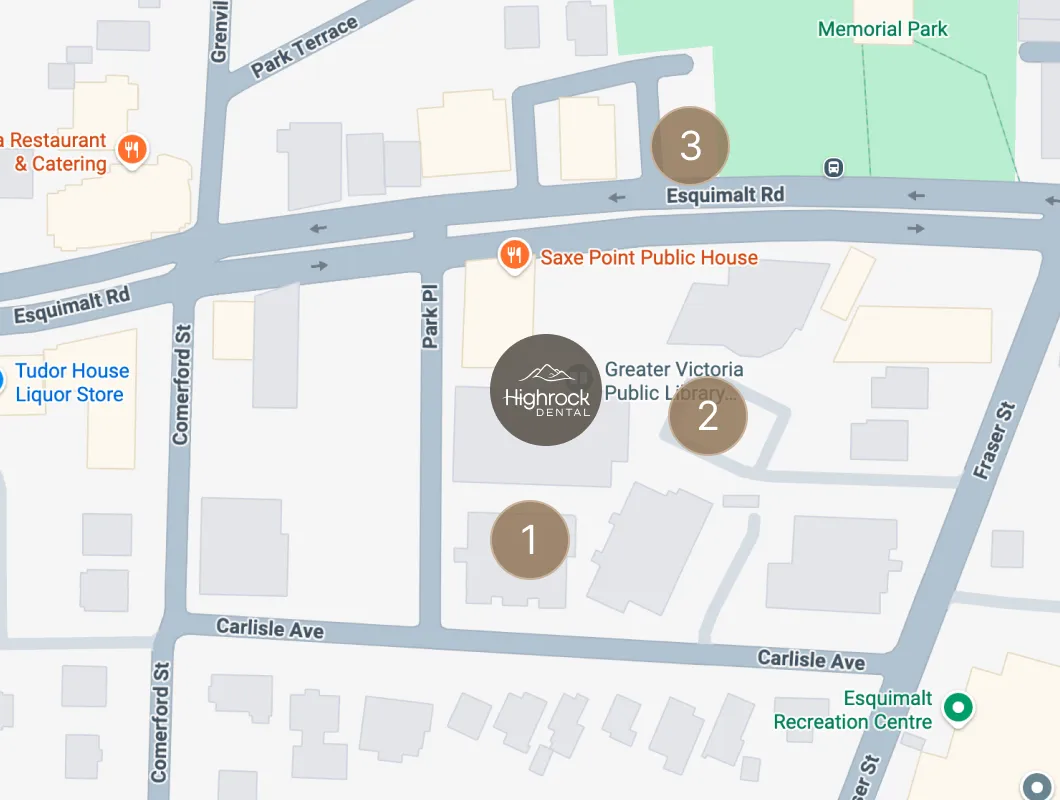
Located on the third floor, two floors above the Esquimalt Public Library. Enter the doors between the library and the coffee shop, take the elevator to the third floor. The office is located to the left when you get out of the elevator. You can access the elevators from the parking garage, take the elevators to the third floor.
503 Park Pl #302, Esquimalt, BC V9A 6Z9- Underground parking in designated stalls in garage off Park Place.
- Above ground parking lot off Fraser St. at $1.50/hr.
- 2hr Free Parking in Public Lot west of Memorial Park.